
Bob Eury: Leader of the Long View
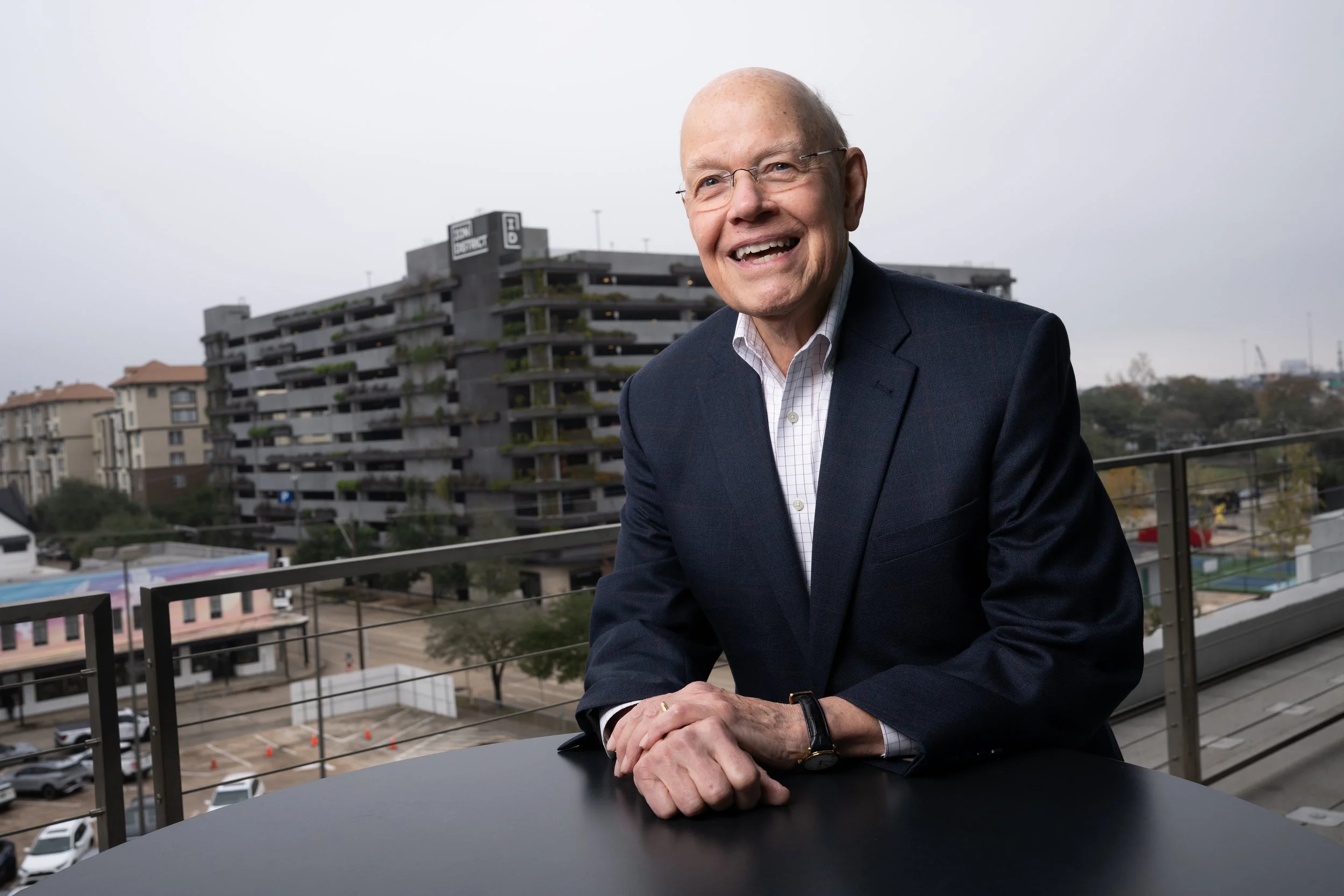
Recently retired president and CEO of Central Houston, Inc. and the Downtown Houston Management District, Bob Eury is a craftsman of urban renewal. He began his training early, growing up in Louisville, KY, then earning his undergrad degree in architecture at the University of Cincinnati. He came to Houston in 1974 for a Master of Architecture in Urban Design at Rice University after a short stint leading research projects for the Urban Study Center at the University of Louisville. He graduated from Rice in 1977 and became vice president and director of research and development for the former Rice University Center for Community Design and Research that crafted “Options for a Unique Texas Place,” the document that eventually led to the formation of the South Main Center Association (now the South Main Alliance).
Former Houston Mayor Annise Parker calls Bob “Mr. Houston.”
Houston was in desperate need of vision and planning by that point. The city was bursting its seams: the 60s and 70s oil boom drew over a million people seeking to take advantage of the hundreds of thousands of new jobs created by the oil industry. The city’s haphazard infrastructure began to collapse; Houston couldn’t build fast enough to meet the crushing demand. With no rail or public transit (METRO came late, created in 1978 by the Texas Legislature) commuting became a horror. Companies fled downtown to the suburbs, giving birth to what are now major economic hubs like the Uptown area around the Galleria, The Woodlands, Greenspoint off Hwy 59 and what is known today as the Energy Corridor off Eldridge and I-10.
Downtown Houston civic and business leaders responded by creating Central Houston, Inc., a 501-c-6 nonprofit designed to unite business, institutional and civic leaders towards the common goal of shaping the economic and cultural revitalization of downtown Houston. They tapped Bob Eury as its first leader.
Stringing together Houston’s “Urban Goodies”.
Learn about the mid-70s NEA grant to develop a unique Texas place.
He started in 1983, literally months before the oil crash, which was a cataclysmic, suddenly rising tidal wave of collapse. Over 200,000 jobs evaporated in a few short years, companies failed, office building rents collapsed, real estate sank and people fled. The oil bust was a depression in every sense of the word, but those who chose to stay persisted and began asking a key question: “how can we make this city better?”
Listen as Bob Eury explains how and why Houston finally began building a rail line.
Different entities emerged to respond to the crisis and Bob collaborated in manifesting HoustonÕs evolution as a global city. Multiple studies and strategic plans recommended the creation of an urban corridor and Bob credits architect and city council member Peter Brown, Ed Wulfe and Mayor Lee Brown for leading the way and creatively cobbling together grant money to manifest that goal. Small projects began, such as planting trees and building sidewalks, and a walkable corridor began to emerge.
From “Astrodomain” to “Reliant Park”: How a turn of phrase resulted in a renewed asset for Houston.
Private investment was key, and private developers joined the planning process. Houston’s fortunes eventually rebounded with a diversified economy that included increased investment in aerospace, medicine and other businesses outside of the oil industry. Investment increased. Each step in the city’s revitalization pushed the city out of its crisis. Key collaborations, such as the one between Central Houston and the South Main Alliance and others, steadily carried the city into the future. Over 680,000 jobs were created by 2000, which was more than those generated during the oil boom.
Bob’s advice for the next generation of civic leaders? Embrace passion and enthusiasm and take risks. The world is rapidly changing, and change is not linear: life would certainly be easier if it were. Have courage and stay steady. There will be disagreement, but larger problems and challenges are worth the investment of time and treasure. Move forward, embrace the thrill and stay on, change is possible, and with persistence, it will happen.